Mouse
The Mouse is one of the first inhabitants of Wonderland that Alice meets after her dramatic fall down the rabbit-hole, and its brief, bristling encounters with her establish the pattern of miscommunication, emotional volatility, and absurd logic that will define her entire adventure. Splashing beside her in the pool of tears, the Mouse initially seems a potential ally, but its fierce hatred of cats and dogs, its pompous recitation of dry historical facts, and its furious departure when Alice fails to pay proper attention all combine to make it a memorable emblem of Wonderland's touchy, irrational social order.
Identity and Introduction
The Mouse first appears in the pool of tears, where Alice, having grown to nine feet high and then shrunk again, finds herself swimming in salt water up to her chin. She hears something splashing nearby and, after briefly imagining it might be a walrus or hippopotamus, realizes it is only a mouse that has slipped in like herself. Alice decides to speak to it, reasoning that in this out-of-the-way place it can probably talk. She addresses it formally, using the vocative case she remembers from her brother's Latin Grammar: "O Mouse." The Mouse looks at her inquisitively and winks one of its little eyes, but says nothing. When Alice tries French, asking "Où est ma chatte?" the Mouse gives a sudden leap out of the water and quivers all over with fright. Alice hastily apologizes, realizing she has forgotten that mice do not like cats.
The Argument Over Cats and Dogs
The Mouse's reaction to the mention of cats is immediate and passionate. In a shrill voice it cries, "Not like cats! Would you like cats if you were me?" Alice tries to soothe it by describing her own cat, Dinah, as "such a dear quiet thing" who sits purring by the fire and is "such a capital one for catching mice." This only makes the Mouse bristle all over. It declares that its family has always hated cats, calling them "nasty, low, vulgar things," and forbids Alice from mentioning the name again. Alice quickly changes the subject to dogs, describing a neighbor's bright-eyed terrier that kills rats, but this offends the Mouse even more, and it swims away as hard as it can. Alice calls after it softly, promising not to talk about cats or dogs, and the Mouse turns back, its face pale with passion, and says in a low trembling voice, "Let us get to the shore, and then I'll tell you my history, and you'll understand why it is I hate cats and dogs."
The Caucus-Race and the Mouse's Tale
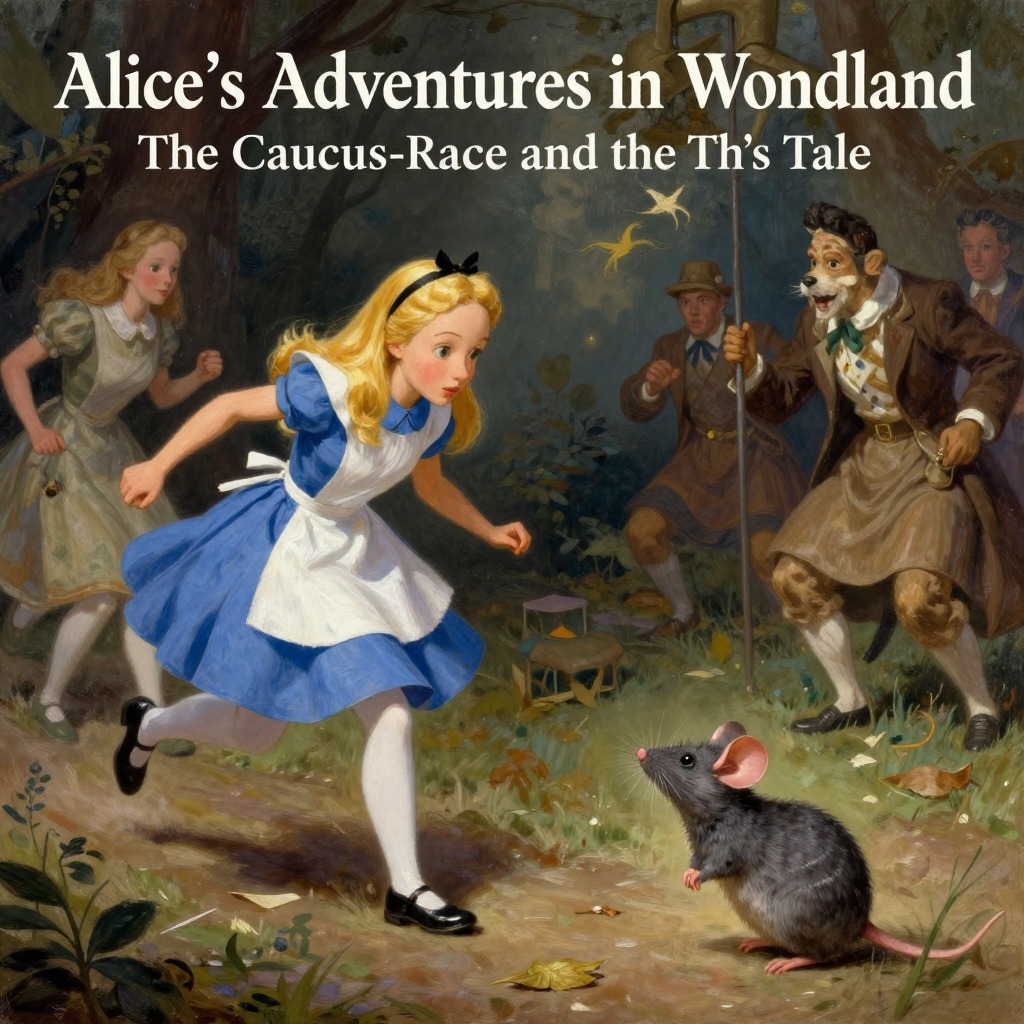
Once on the shore, the Mouse assumes a position of authority among the dripping-wet birds and animals. It calls them all to sit in a large ring and announces that it will make them dry by reciting "the driest thing I know"—a dry historical account of William the Conqueror. The recitation is repeatedly interrupted by the Lory, the Duck, and the Eaglet, who find it tedious and incomprehensible. The Dodo eventually proposes a Caucus-race as a more energetic remedy, and after the race the party begs the Mouse to tell them something more. Alice reminds it of its promise to tell its history and why it hates cats and dogs, whispering "C and D" to avoid offending it again. The Mouse sighs and says, "Mine is a long and a sad tale!" Alice, looking down at its tail, mishears "tale" as "tail" and wonders why it calls it sad. The Mouse then delivers its tale in the form of a concrete poem shaped like a tail, in which a character named Fury prosecutes a mouse and condemns it to death. Alice, distracted by the visual shape, fails to attend to the words, and when the Mouse asks sharply what she is thinking of, she replies that she thinks it had got to the fifth bend. The Mouse cries angrily that it had not, and when Alice offers to help undo a knot, it gets up and walks away, saying, "You insult me by talking such nonsense!" Despite Alice's pleas and the chorus of the other animals, the Mouse only shakes its head impatiently and walks quicker until it is out of sight.
Consequences and Thematic Significance
The Mouse's departure leaves Alice feeling lonely and low-spirited. She wishes aloud that she had Dinah there to fetch it back, but mentioning Dinah's skill at catching mice and birds causes the other animals to flee as well, and Alice is soon left entirely alone. The Mouse thus serves as a catalyst for Alice's first experience of isolation in Wonderland, a pattern that will recur throughout her journey. Its extreme sensitivity, its insistence on being listened to with perfect attention, and its readiness to take offense at the slightest misstep all exemplify the fragile, rule-bound social interactions that govern Wonderland. The Mouse's tale, with its pun on "tale" and "tail" and its concrete visual form, also introduces the book's characteristic play with language and typography, where meaning is as much a matter of shape and sound as of content. In the end, the Mouse is a creature of pure reaction: it hates cats, it hates dogs, it hates being misunderstood, and it will not stay to be insulted. Its brief, bristling presence leaves Alice with her first lesson in the difficulty of communicating in a world where words can wound and where the simplest conversation can spiral into offense and abandonment.